




ESPAÑOL   |   ENGLISH

Budget Basics

Shopping Smarts

Most consumers have spent $816 buying gifts in '07

By David Burge / El Paso Times


Now is also the perfect time to take a few moments to review how you did financially this holiday season and make plans to do better in 2008.

Maybe you still have Christmas shopping to finish today or you need to gift-wrap the loot you've bought already for friends, family and co-workers.

But now is also the perfect time to take a few moments to review how you did financially this holiday season and make plans to do better in 2008.

"Thousands of people every year spend more than they should and more than they plan to because they got caught up in the season," said Mike Sullivan, director of education for Take Charge America, a credit-counseling and debt-management company based in Phoenix. Jan. 15 to Feb. 15 is usually the busiest time of the year for Sullivan's company, he said. "That's when the credit-card bills come in, and they see what they spent during the holidays and they realize they can't make the payments," Sullivan said.

The average U.S. consumer was expected to spend $816.69 on holiday-related shopping and an additional $106.67 on themselves this season, according to the National Retail Federation.

Westsider Richard Ahumada starts saving for Christmas in January each year and regularly tucks money into a special Christmas savings account at his credit union. He tries to pay cash for gifts and any traveling he or his family does during the holiday season. "You definitely don't want to use your credit cards and pay interest," Ahumada said. "The interest they charge will eat your lunch really quick." Greg McBride, a senior financial analyst with Bankrate.com, said, "Without proper planning for holiday shopping, consumers can undo much of the financial progress they've made all year long." "The holiday season is also a time when households dig their debt hole that much deeper," he added.

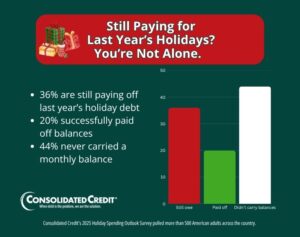
Howard Dvorkin, founder of Consolidated Credit Counseling Services Inc., based in Florida, said the tendency for many consumers is to charge their holiday purchases even though they may still be paying off last year's Christmas or even the holidays from five to seven years ago. Start planning ahead and saving for next year, Dvorkin said.  Also, you might consider alternatives to expensive gifts, such as giving the gift of time to someone or making homemade presents, he suggested. There's no need to bust the bank," he said.

El Paso certified public accountant Steve Rash advises consumers to start shopping earlier in the season, instead of waiting until the last minute. "If you wait until the last minute, you'll be panicky," he said. "You might end up spending more money than if you started earlier and were more organized."

Try to pay for your holiday purchases in cash, he said. If that's not possible, use a low-interest credit card and pay it off as soon as possible, he added. Another trick when using credit is to keep a running total of how much you charged, almost as if you were writing checks, Rash said. This helps you keep better track of how much you've actually charged, he said.

Some tips on how to do a better job next holiday season with your finances:

·  Take a look at how you did this year. Create your own "little scorecard," McBride said. Examine your holiday purchases and determine the proportion you paid for with savings versus credit cards.

Pull out your credit-card and bank statements and come up with an accurate assessment of your holiday spending, including entertainment, said Maureen Hankins, director of the El Paso YWCA's Consumer Credit Counseling Service.

"Most people have in the back of their minds that they'll try to stay under $25 for all these people they're buying for, but then they'll see that 'perfect gift' for $30 or $50," Hankins said.

What happens is that you end up busting your budget and spending way more than you planned, she said.

·  Once you've figured out how much you spent this year, create a budget for next year and stick with it, experts say. Look at unnecessary spending that can be eliminated next year, Hankins added.

·  Start saving right now. Put enough away each month so you can cover next year's holiday expenses. Factor in gifts, traveling, decorations, holiday entertainment and going out to eat, experts say.

If your holiday budget is $1,200, start saving $100 a month right now, Rash said.

·  You also need to be realistic about your spending plans, Sullivan said.

You might be able to save some money by shopping online, but make sure you factor in shipping and handling charges and taxes, he said.

"That $50 gift could end up being an $80 gift," Sullivan said.

·  Check with your bank or credit union to see whether it has a special Christmas Club program, Dvorkin said, but make sure it pays a decent interest rate.

You can also visit Bankrate.com, which has a free search engine to help you find the highest-yielding savings accounts.

·  If you ran up holiday debt this year, resolve to pay it off as soon as possible, while still saving for Christmas 2008.

At the very least, pay off this year's holiday debts by the time next year's season rolls around, Hankins said.

·  Approach your holiday plans with discipline. Save up ahead of time and don't touch the money, experts said.

If you see a bargain next year and you know it's the perfect gift, go ahead and buy it, even if it's nine months before Christmas, Dvorkin said.

But pay for these early purchases in cash, he cautioned. A bargain really isn't a bargain if you charge it and have to pay interest, Dvorkin said.