





ESPAÑOL   |   ENGLISH

Holidays

Be of good cheer, but watch your wallet

Tribune Staff and Wire Services
November 24, 2004
 

Each year, Barbara Park starts her holiday gift shopping early. Not only does the West Jordan woman need time to find gifts for her 12 grandchildren, it allows her to get better bargains.

"I know what the kids want," she said, which is one reason she doesn't impulse buy.

Park, who started shopping in August, said she will spend more on gifts this year than last, but said she can do it because she planned ahead. With another month before Christmas, she only has to get one more gift.

Like Park, many consumers are expected to spend more on gifts for family, friends and co-workers. But financial planners advise consumers to take a close look at their resources before racking up purchases.

Many consumers' financial goals tend to fall by the wayside during the holidays.

Before shopping, consumers should create a budget and calculate how much they can afford to spend, experts say. The budget should include spending limits on specific items - such as gifts for individual people, decorations, party clothes and food.

Ideally, consumers should set aside money during the year based on how much they spent the year before.

And consumers should have a dollar amount in mind for particular gifts before walking into a store. Vague budgets and gift ideas lead to overspending.

''I tell people not to compare their family to others,'' says Beth Snyder, budget counselor for the Manitowoc, Wis., office of Catholic Charities. ''Remember the true meaning of Christmas. Give gifts that cost little but have meaning.''

According to America's Research Group, a consumer behavior research firm in Charleston, S.C., 38 percent of consumers spend more than they planned during the holidays.

One reason: They wait till the last minute to shop.

''Starting to shop early gives you a lot more time to find better bargains and be a better shopper overall,'' says Jim Tehan, a spokesman for Myvesta.org, a Rockville, Md.-based company that offers financial-planning services.

Consumers will spend an average of $702 on the holidays this year, up 4.5 percent from last year and the highest since 2001, according to a National Retail Federation survey.

Total holiday spending is estimated to reach $220 billion.

''They are not at the point where they are ready to let loose like drunken sailors,'' says Phil Rist, vice president of strategy for BIGresearch, which conducted the survey of more than 7,000 consumers for the retail group.

''But they are feeling better about the economy.''

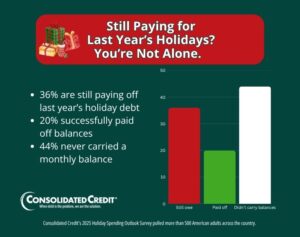
Many will use credit cards, but financial planners recommend using cash - particularly if consumers already are in debt. Between 60 percent and 65 percent of consumers have an existing balance on their credit card, according to Consolidated Credit Counseling Services in Fort Lauderdale, Fla.

In 2003, consumers had an average of $2,294 in credit card debt spread out on two cards, according to Myvesta.org.

People who can't afford a credit card's minimum payment, who are using a cash advance from another card to pay the minimum, or who are postponing basic needs such as a doctor's appointment because they're tight on cash, should think twice before buying any gifts, says Howard S. Dvorkin, founder of Consolidated Credit Counseling Services.


Tips for holiday spending

* Create a budget and stick to it.

* Make a list of the people for whom you are buying gifts. Set a dollar limit on each one.

* Don't wait until the last minute to start shopping. You will miss the best deals.

* Find a fabulous deal? Buy several and give to different people, especially if the recipients never will meet.

* Consider giving young children one or two larger gifts instead of a pile of smaller gifts. Give older kids gift certificates so they can take advantage of post-holiday sales.

* Keep track of your spending.

* Avoid using your credit card.

* Avoid all skip-payment and buy-now-pay-later offers.

* Be candid with family and friends if times are tough.

* Don't buy a gift you can't afford.

* Be creative. Offer your time or services or make your own presents.

* Open a Christmas club or other savings account. It's never too early to start setting aside for next year.

* Check out sites like Bankrate.com and ConsolidatedCredit.org for more budgeting tips and spending calculators