




Holidays
Be ready when big holiday bills roll in.

Are you feeling the holiday hangover yet? No, not the one from too much partying on New Year's Eve.
"The biggest surprise is not what's under the Christmas tree. It's what comes in January and February when the bills start rolling in," says Howard Dvorkin, founder of Consolidated Credit Counseling Services Inc.
Business will boom in the coming weeks at Dvorkin's Fort Lauderdale-based debt counseling agency. It's an annual rite, and the numbers seem to be increasing every year.
"Most people spread out their holiday purchases over four or five credit cards," he said. "By the time the holiday season is over, they have no idea what they spent, which is a huge problem."
Some 26 percent of Americans use credit cards most often when holiday shopping, pumping up the $63.6 billion charged on credit cards throughout the shopping season, according to a poll by Consumer Reports magazine.
Twenty-three percent of those shoppers say they won't pay off their debt until March or later.
"Credit cards can be hazardous to your holiday season," said Tod Marks, senior editor at Consumer Reports.
"With the average household saddled with $9,000 in credit debt already, anything that significantly adds to that impost could be potentially devastating," he said.
Those who used credit cards said they planned to charge more than $1,000 for holiday gifts this year.
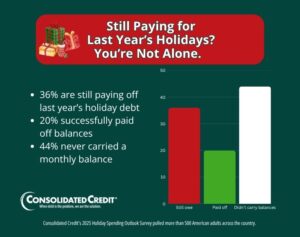
In its latest survey, Consolidated Credit found that 44 percent of shoppers are still paying off debts from last year's holiday season.
This year, 30 percent say they plan to pay off their holiday debt within three months, and 25 percent expect to be done within 12 months.
Fifteen percent say they can pay off their debt in a lump sum, while 30 percent say they aren't concerned about paying off that debt.
Estimates varied on how much shoppers would spend at Christmastime.
The National Retail Federation projected the average consumer spending $791.10 in the recent holiday season, up from $738.11 in 2005. Shoppers also would spend nearly $100 on themselves.
"Even with good intentions, strict budgeting and planning ahead, it can be difficult to avoid getting caught up in the holiday cheer and overspend," said Matt Coffin, president of LowerMyBills.com.
Bracing for business
The Consumer Credit Counseling Service of Central Florida & the Florida Gulf Coast, which includes Sarasota and Manatee counties, is bracing for the annual rush of holiday overspenders.
"Credit cards are part of our society and part of our culture," said Richard Schram, the agency's quality assurance and special projects manager.
"What happens is that people tend to view credit cards not as money -- 'I can buy something and pay for it later.' When that gets out of hand, it can really be a problem for the individual."
"The rule of thumb is if it takes you more than three equal payments to pay off a credit card, then you could have a credit card problem," he said.
Buying a big-ticket item on credit also can become a big long-term expense.
Say you bought an entertainment system for $5,000 with a credit card. At 18 percent interest, and making only the minimum payment each month, it will take 33 years to wipe out the debt, which over time will total $12,000.