






ESPAÑOL   |   ENGLISH

Holidays

HOW TO MAKE MERRY WITHOUT GOING BROKE This week, Gail explains how to avoid tricks designed to get you to overspend this holiday season

By Gail Buckner, CFP
Fox News

It is the “Mother of All Mall Days.”The day after Thanksgiving traditionally marks the start of the holiday shopping season. And for the increasing number of online shoppers, there is “Cyber Monday,” the first work day after Thanksgiving and the day many of us sneak in our Internet shopping.

Regardless how you do it, holiday spending significantly contributes to this country’s increasing consumer debt problem.

Depending upon which survey you care to believe, Americans are either: a) Likely to cut back on how much they spend compared to last year (so says The Conference Board, Credit Union National Association, and Consolidated Consumer Credit Counseling Services), or b) Likely to spend more (this from the National Retail Federation and Visa USA).

Aside from the obvious fact that you can pretty much get out of a survey whatever result you’re looking for based on the way you frame the questions, another reason for these two completely opposite predictions is that these surveys are very subjective. That is, they rely on consumers own self-evaluations.

If you’re feeling especially optimistic when get the phone call from the survey-taker, you’re likely to magnanimously respond that you are going to be more generous this year.

On the other hand, if you’ve got visions of lumps of coal dancing in your head because your kids have just decorated the walls with their crayons or your significant other has ticked you off, you’d probably say you plan to spend less.

Furthermore, since it’s human nature to want others to think highly of us, our answers are also influenced by what we think we should say. Which explains why, despite telling a researcher that we’re sticking to a budget this year, once the actual sales numbers are added up, they indicate we tend to overspend our budgets by 20 percent or more.

Nonetheless, the annual shopping survey conducted by the non-profit Consolidated Credit Counseling Services found that the No. 1 reason nearly 60 percent of us are trimming our holiday budgets this year is that we’re already up to our eyeballs in debt. Surprisingly, slightly more men than women cite this reason.

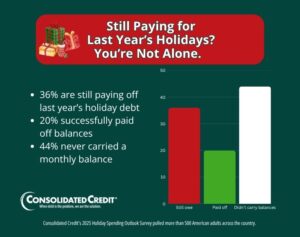
And 46 percent of those surveyed are still paying off charges they ran up this time last year! This number is even higher — 54 percent — in the Northeast.

In addition, 82 percent of us already expect to be paying off this year’s holiday debt well past March — a statistic that undoubtedly has credit card issuers jumping for joy.

And don’t even think about accepting those seemingly generous offers to “Take a Holiday From Your Credit Card Bill” and skip your December payment. “All that means is no late fee will be charged and the skipped payment won’t go against your credit report,” says Gary Herman, president of the non-profit Consolidated Credit Counseling Services.

If you accept this offer, you’re actually making a gift to your credit card issuer because interest will still accumulate. “It’s just another way to drive up the balance so the credit card company earns more interest in January,” says Herman.

While we’re on the subject of Trojan horse offers, avoid those tempting “10-15 percent off” come-ons for opening a store credit card account. These merchant cards tend to carry much higher interest rates and fees than bank cards.

What’s more, says Emily Davidson, communications director at for-profit credit.com, the 15 percent you save on your purchase “is going to be quickly out-weighed by the negative impact of opening the new account.”

If you want to make a large purchase that you know you’re going to take several months to pay off, Herman says you “may be better off putting this on a low-interest credit card you already have.”

He defines this as one with an interest rate of 15 percent or less. In the long run, this will end up costing you less than “a 10 percent discount at the counter and getting hit with 21 percent interest over the next year.”

Keep track of your credit limit — both in total and on each card. A critical measure of how credit-worthy you are is your “credit utilization” or “debt-to-limit” ratio. It’s the percentage of your total available credit that you’re actually using. Racking up $1,000 in charges on a card with a $2,000 limit means your debt-to-limit ratio is 50 percent.

That’s a red flag to lenders, according to Davidson. “The lower you keep your utilization ratio, the better.” If you want a high credit rating, she maintains you should aim for this ratio to be under 10 percent.

It’s also important to know the limit on each credit card because exceeding it can trigger what Herman calls “excessive” charges. “It can result in your interest rate being increased to 29 percent.” In addition, he says the “over-limit” fee can run as much as $39 a month until the card is back below your limit.

Another trap for the unwary: Charging a lot of small purchases on your credit card knowing you’re going to pay them in full when your statement arrives next month. You only avoid interest on these charges if the card you’re using has a zero balance.

“There’s no grace period for cards with existing balances,” says Herman. “If you charge $50 worth of gas on a card that already has a balance, you pay interest from the day you pump it.”


 1   |  2 »