In Consolidated Credit’s first Credit Card Anxiety Index, 61% of Americans said they worry about how much they owe on their credit cards. For many, that worry isn’t a passing thought. It shows up in their mood, their willingness to open their own mail, and how much they’re willing to tell the people closest to them.
This inaugural survey set out to measure something most credit card research skips over: not just what people owe, but how carrying that debt makes them feel, what changes by generation, and what, if anything, people are doing about it.
Key findings
- Most Americans (61%) worry about their credit card debt, and half of those who worry say it affects their mood at least several times a week.
- Worry peaks in midlife, not old age. Three in four Americans ages 30 to 44 (75%) worry about their credit card debt, compared with 34% of those over 60.
- Older worriers keep it to themselves. Among Americans over 60 who worry, 60% say no one in their life knows how they feel about their credit card debt, nearly triple the rate among 30- to 44-year-olds (22%).
- People worry most about interest, but income and living costs drive more enrollments. Interest piling up is the top worry among survey respondents (34%). In Consolidated Credit’s debt management plan (DMP) records, reduced income is the most common reason clients enroll (33%), and rising living costs are the most common theme in counselors’ notes for clients who cited another reason.
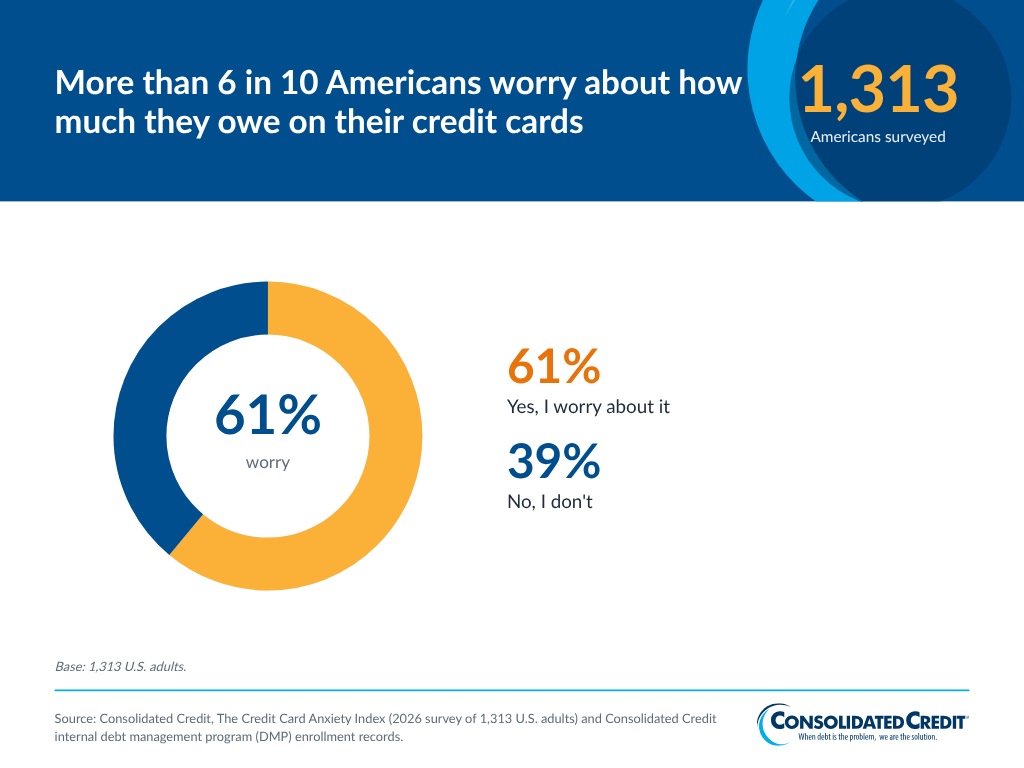
he index opened with a simple question: Do you ever worry about how much you owe on your credit cards? Answering yes didn’t require the worry to be constant or severe, only present. Of 1,313 respondents, 806 said yes. The other 507 said no. That group includes anyone who pays the full balance every month and anyone without a credit card, because the survey didn’t ask about either.
That makes 61% a share of all U.S. adults, not just people with credit card debt.
Among Americans who carry a balance from month to month, the share who worry is almost certainly higher. Only the people who said yes went on to answer the questions about mood, statements, disclosure and coping, so the percentages in those sections describe worriers specifically. For example, a finding that applies to a third of worriers reflects about one in five American adults.
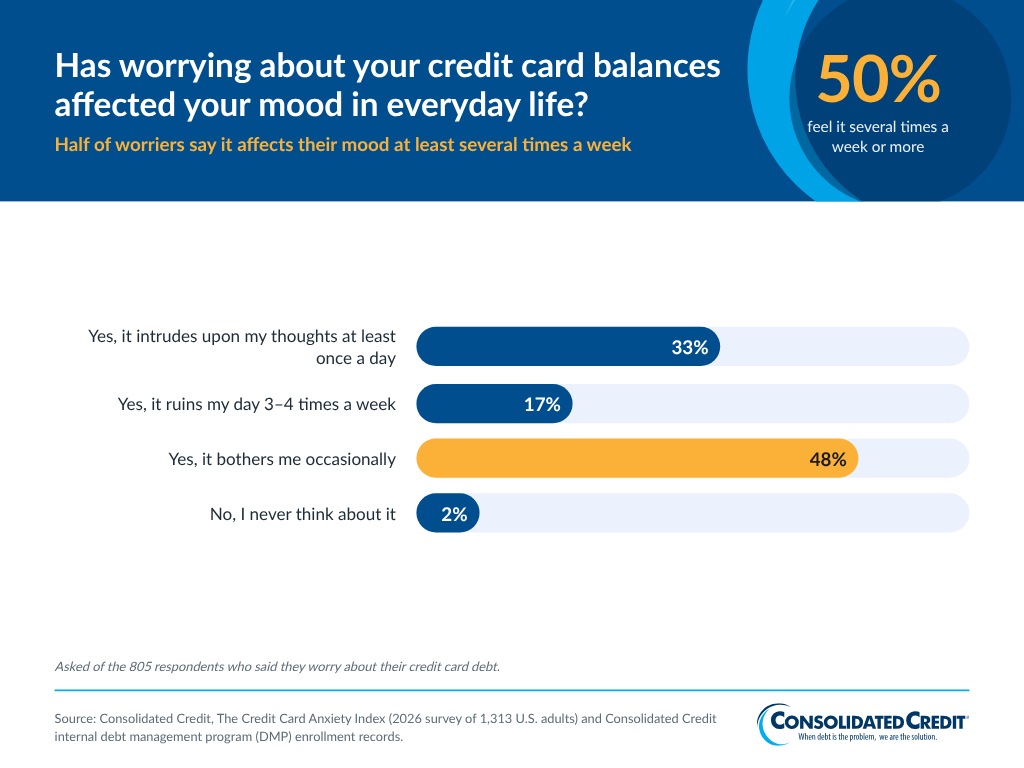
For half of worriers, credit card debt is a background hum rather than a constant intrusion. But for one in three, it’s closer to a daily fixation: worry that shows up whether or not anything about the balance has actually changed that day.
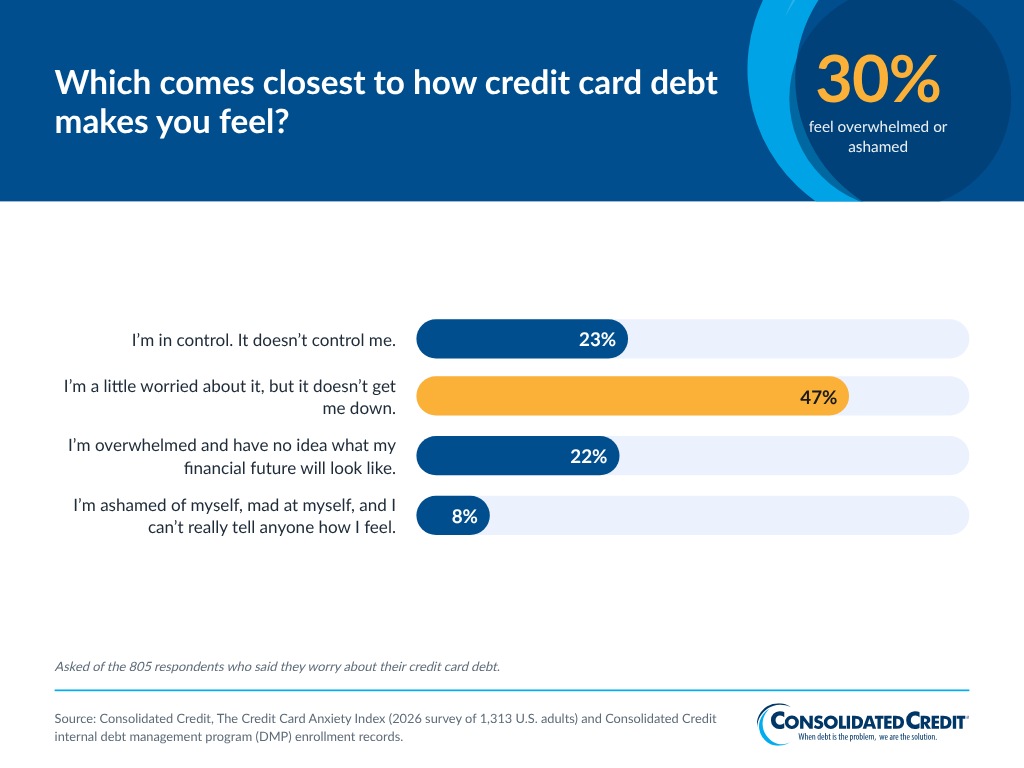
Nearly a third of worriers describe feelings that go beyond ordinary concern: overwhelmed about the future, or too ashamed to talk about it. That’s a meaningful share of people for whom credit card debt isn’t just a financial fact, but an emotional one.
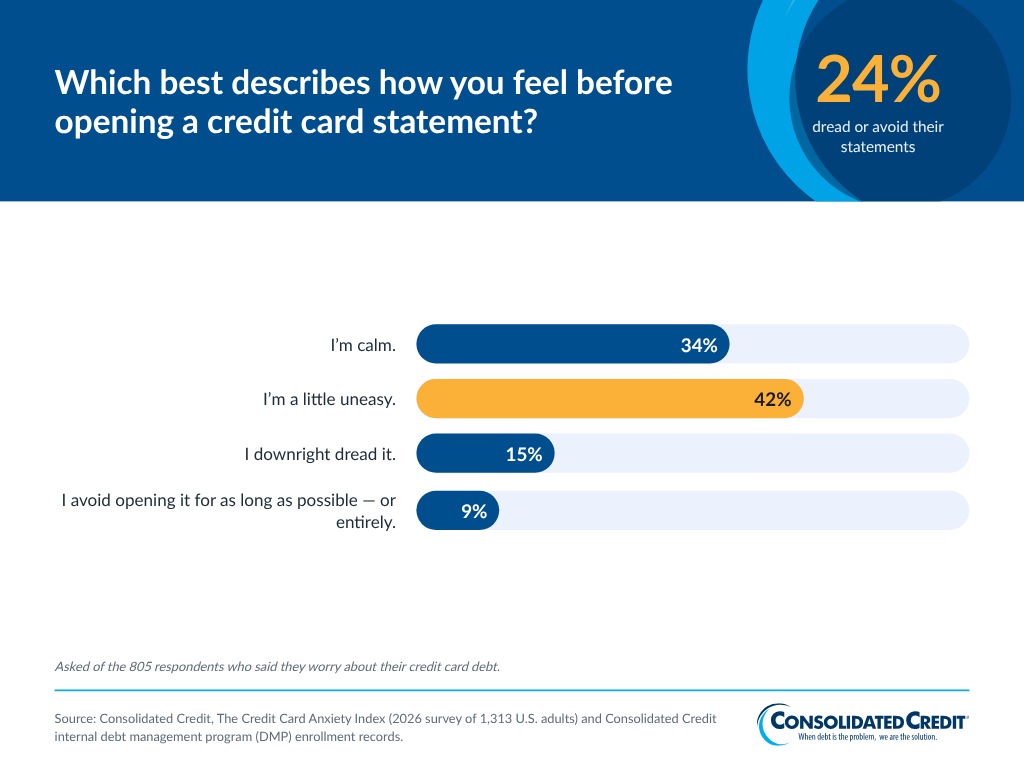
Nearly a quarter of worriers actively dread or avoid their own statements. That avoidance is worth watching. It’s the kind of behavior that can let a balance grow quietly while the anxiety about it grows right along with it.
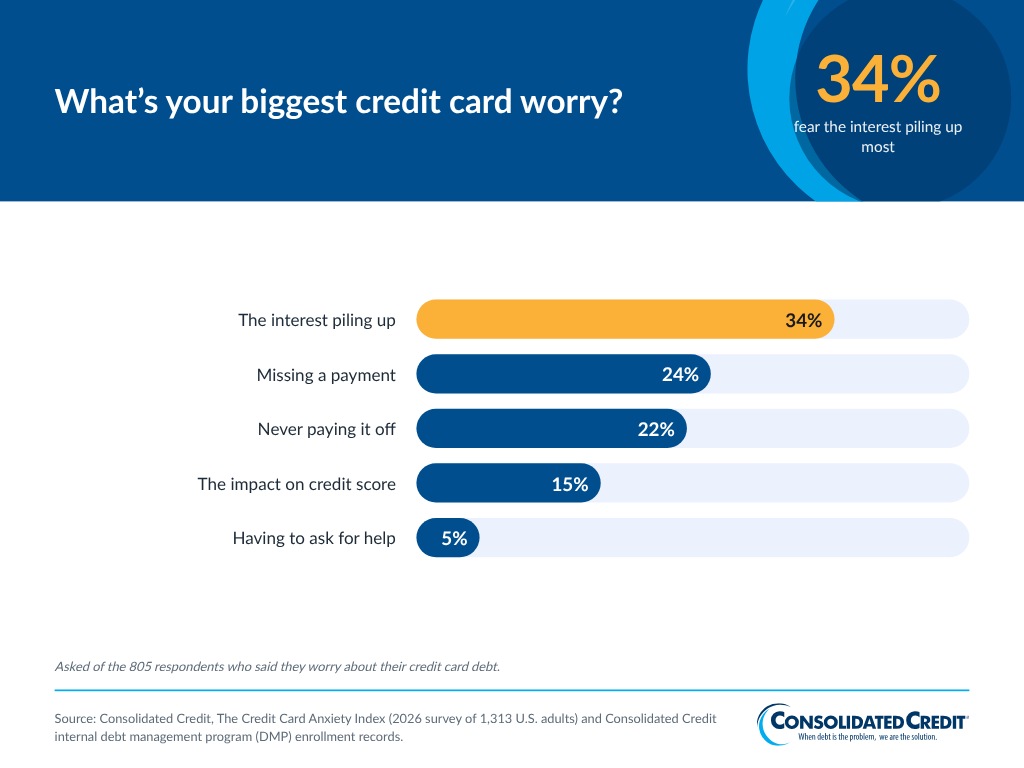
Interest is the single biggest source of worry, named by a third of respondents. Notably, “having to ask for help” ranks last: a hint that for most worriers, the psychological barrier isn’t pride, it’s the debt itself.
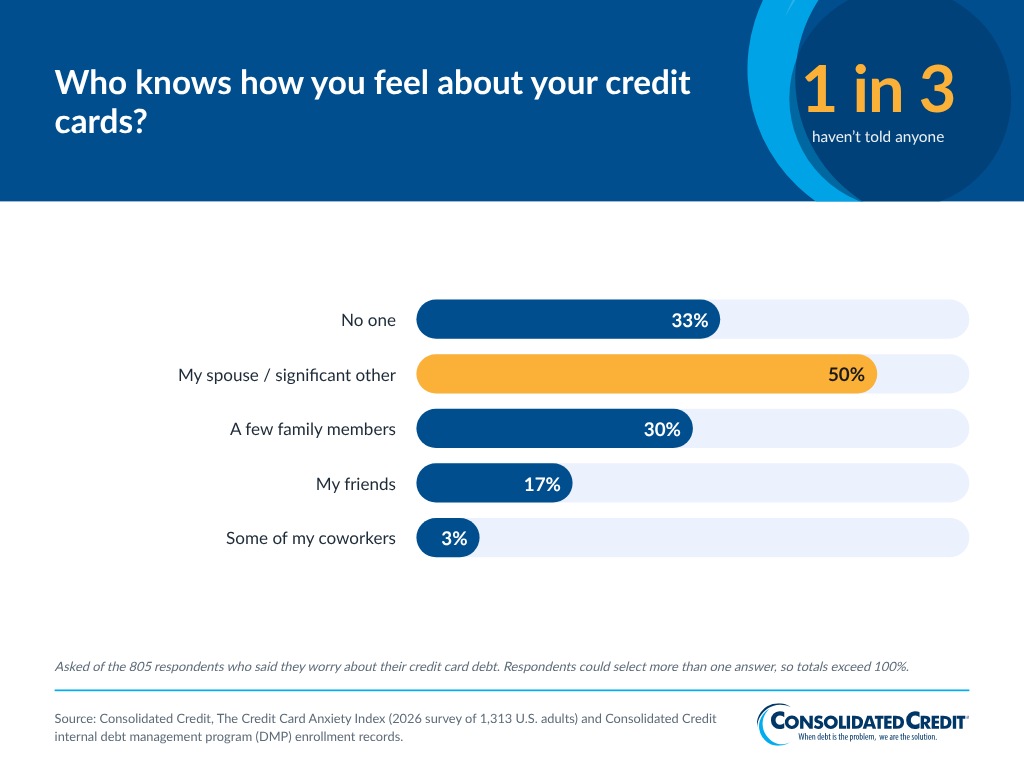
A third of people who worry about their credit card debt haven’t told a single person. Half say a spouse or significant other knows.
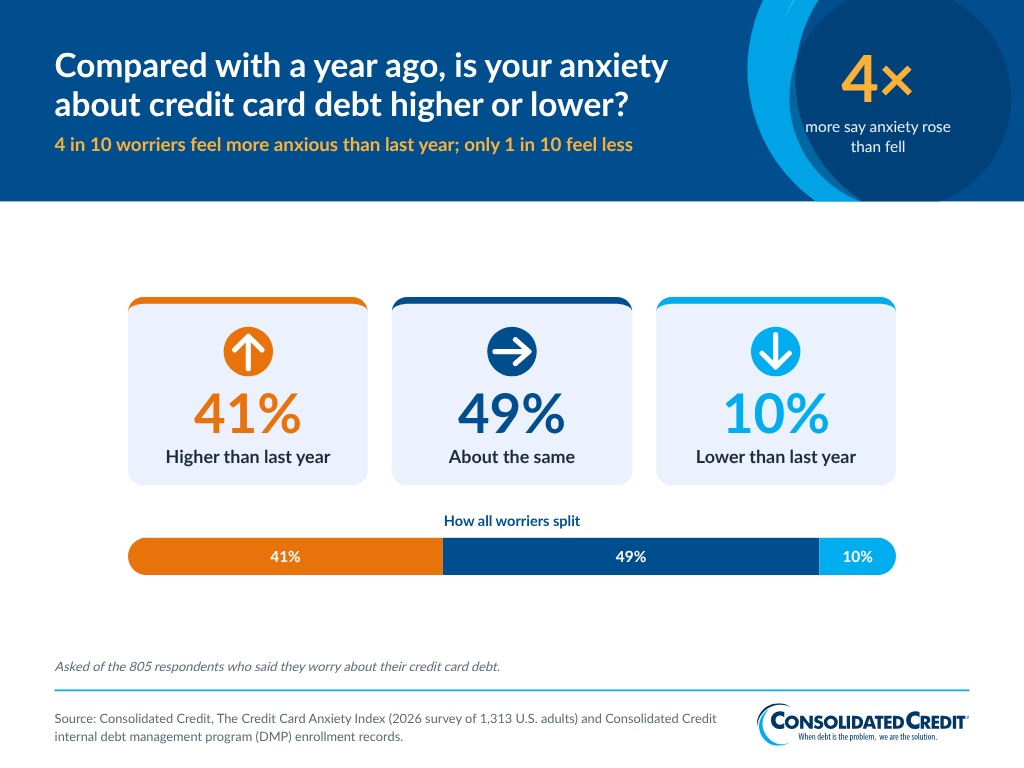
Four times as many worriers say their anxiety has gotten worse over the past year as say it’s improved. As a baseline year, this gives Consolidated Credit a number to track going forward. But on its own, it already shows an emotional burden trending in the wrong direction for a meaningful share of people.
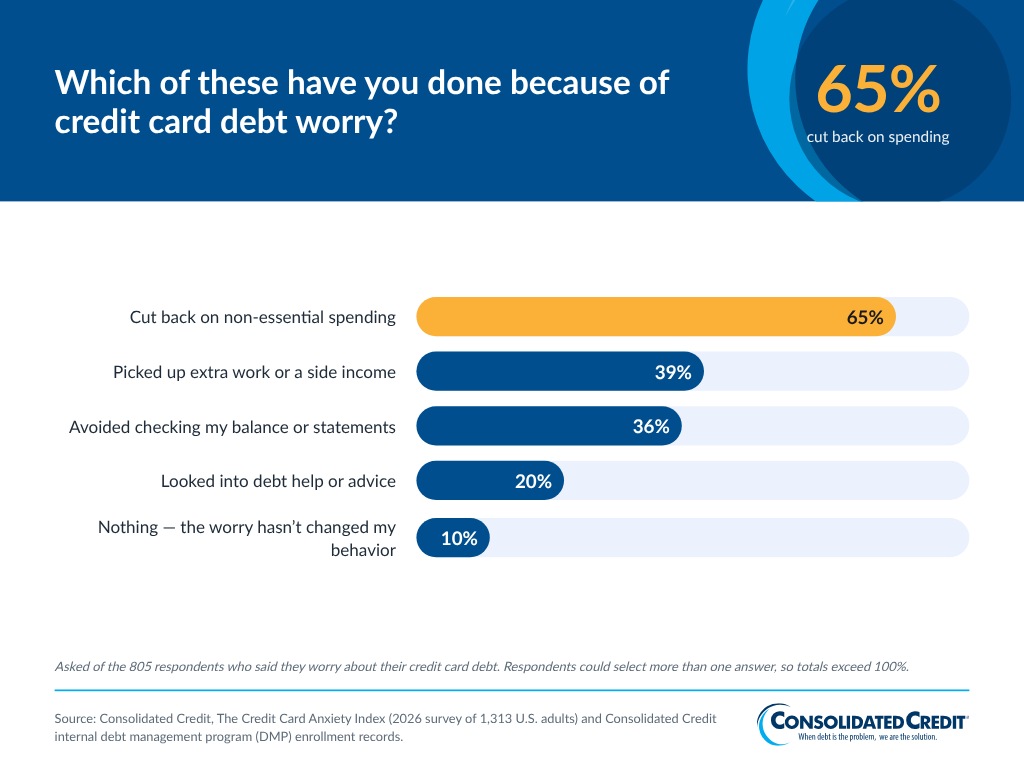
Cutting spending and picking up extra income are the two most common responses: practical, self-directed steps. But more people say they’ve avoided checking their balance (36%) than say they’ve looked into debt help or advice (20%). Worry is clearly driving behavior for most respondents; it just isn’t always driving them toward help.
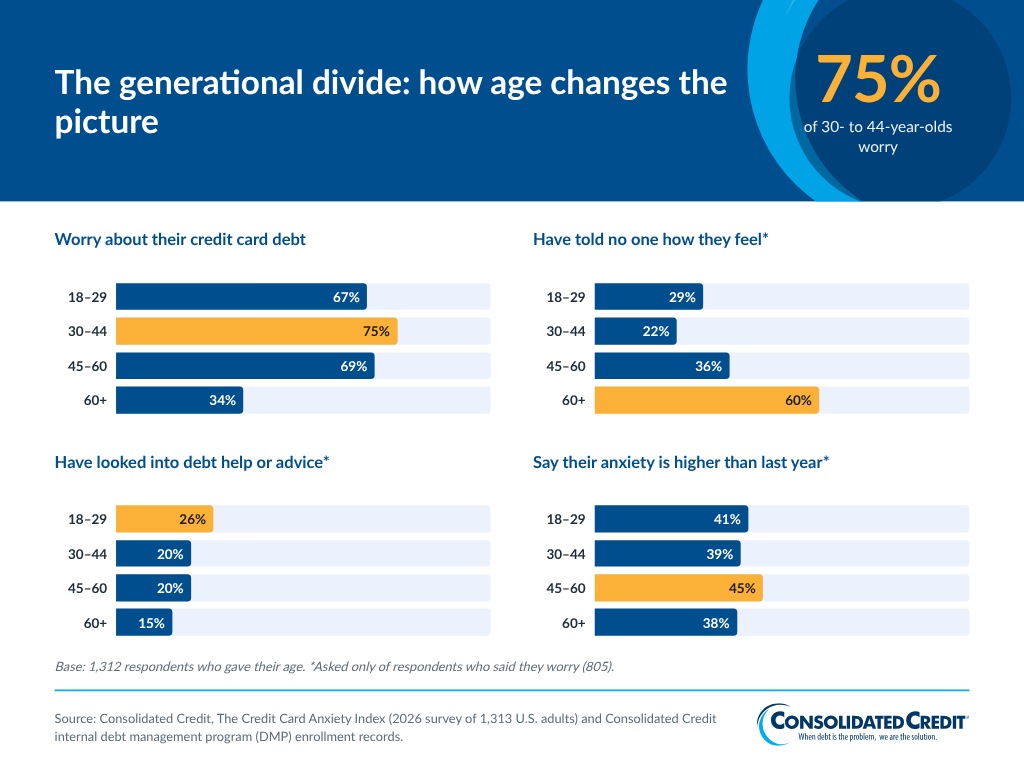
Worry drops off a cliff after 60. Two-thirds of 18- to 29-year-olds (67%), 75% of 30- to 44-year-olds and 69% of 45- to 60-year-olds say they worry about their credit card debt. That falls to just 34% once people pass 60, the sharpest single break in the entire dataset. This survey can’t say why (lower balances, paid-off mortgages, and different risk tolerance could all play a role), so it’s a finding to note rather than explain.
Older worriers are the most isolated. Even though far fewer people over 60 worry in the first place, the ones who do are by far the least likely to tell anyone: 60% say no one in their life knows, compared with 22% of 30- to 44-year-olds. Spousal disclosure follows the same pattern: 66% of worried 30- to 44-year-olds say a spouse or partner knows, versus 28% of worried people over 60.
Young adults are the most anxious avoiders and the most active help-seekers. Respondents ages 18 to 29 have the highest rate of avoiding their own statements and, separately, the highest rate of having looked into debt help or advice (26%, versus 15-20% for every other age group). The two behaviors look contradictory, but together they suggest a group that’s anxious about the problem while also more willing than older generations to do something about it.
Credit score worry is a young-and-old story. Worry about credit score impact is highest among 18-29-year-olds (21%) and people 60 and older (20%). But for different reasons. Younger respondents may still be building their credit, while older ones are trying to protect a credit history they’ve spent decades building. Worry drops to 12-13% among 30-44- and 45-60-year-olds, who are more focused on the interest piling up and the balance itself.
How this compares to real enrollment data
Source: Consolidated Credit’s internal DMP enrollment records, not the SurveyMonkey survey referenced throughout the rest of this report.
Consolidated Credit’s own debt management plan (DMP) enrollment data offers a way to check the survey’s stated worries against what’s actually driving people to seek help.
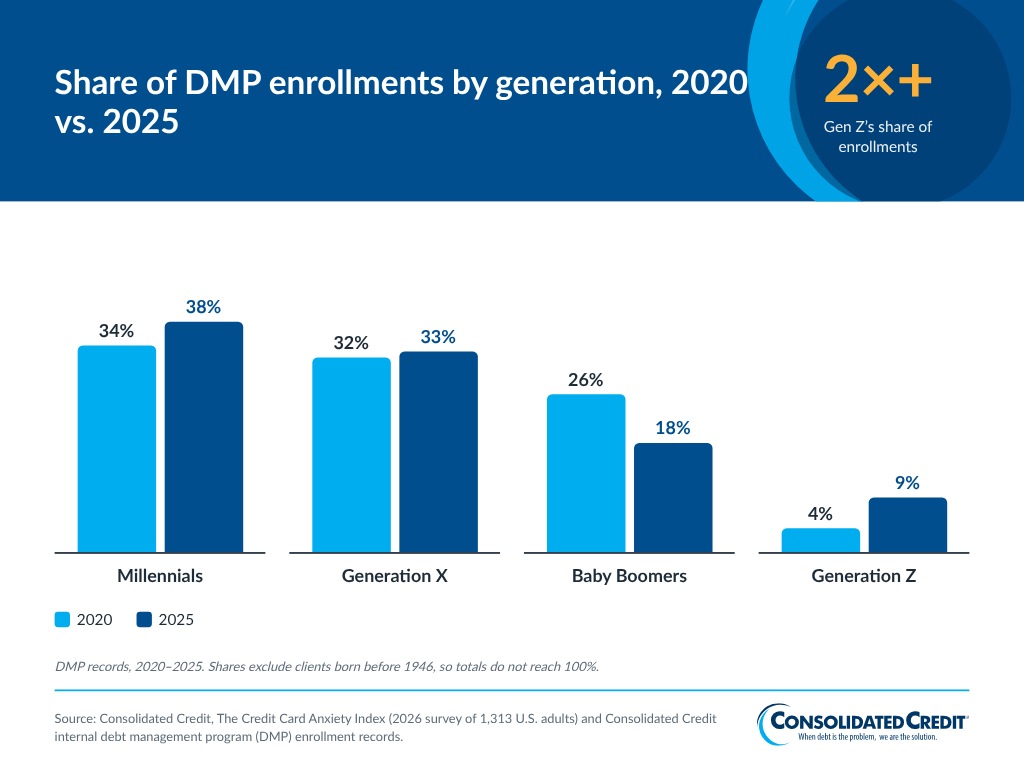
Millennials and Generation X, who map closely to the survey’s highest-worry 30-44 and 45-60 age bands, have made up about two-thirds or more of DMP enrollments every year since 2020, and Millennials’ share has grown. Baby Boomers’ enrollment share has shrunk by nearly a third over the same period, consistent with the survey’s finding that worry drops sharply after 60. Generation Z’s share has more than doubled, though that’s worth a caveat: some of that growth is simply more Gen Z consumers aging into credit card use each year, not necessarily a sign that each individual is more distressed than before.
What people say worries them lines up with, but isn’t identical to, why they actually enroll. Among the reasons all 20,458 DMP clients cited for enrolling in the last 12 months:
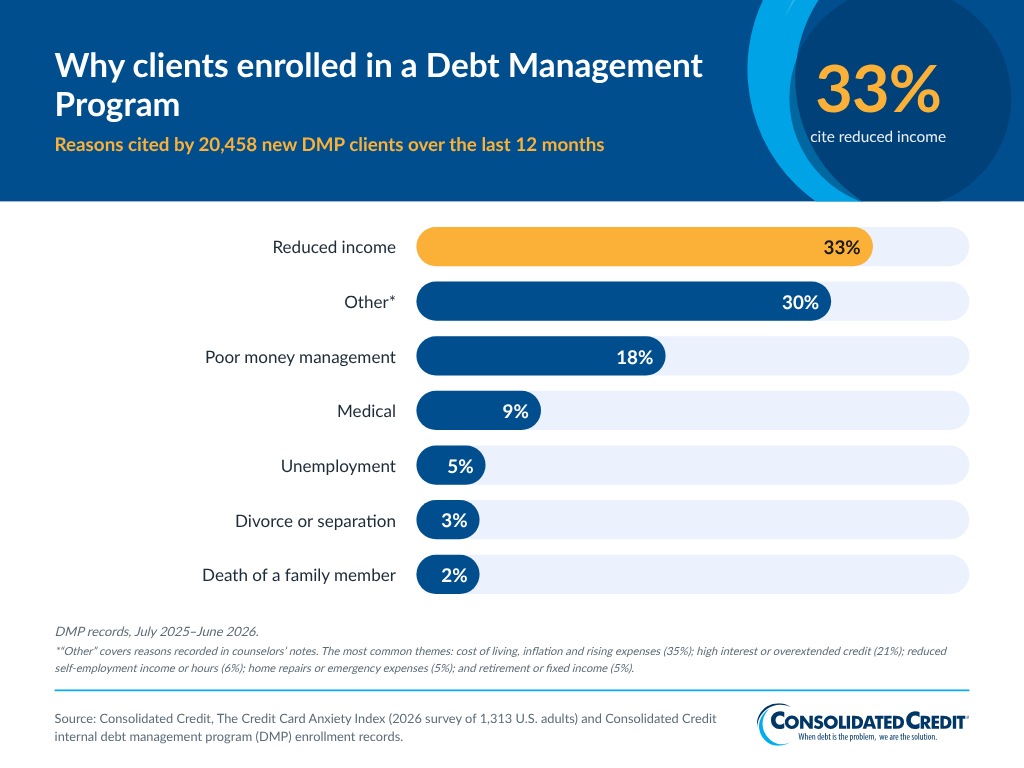
Of the 6,212 clients who cited “Other” and gave a written explanation, the most common themes were:
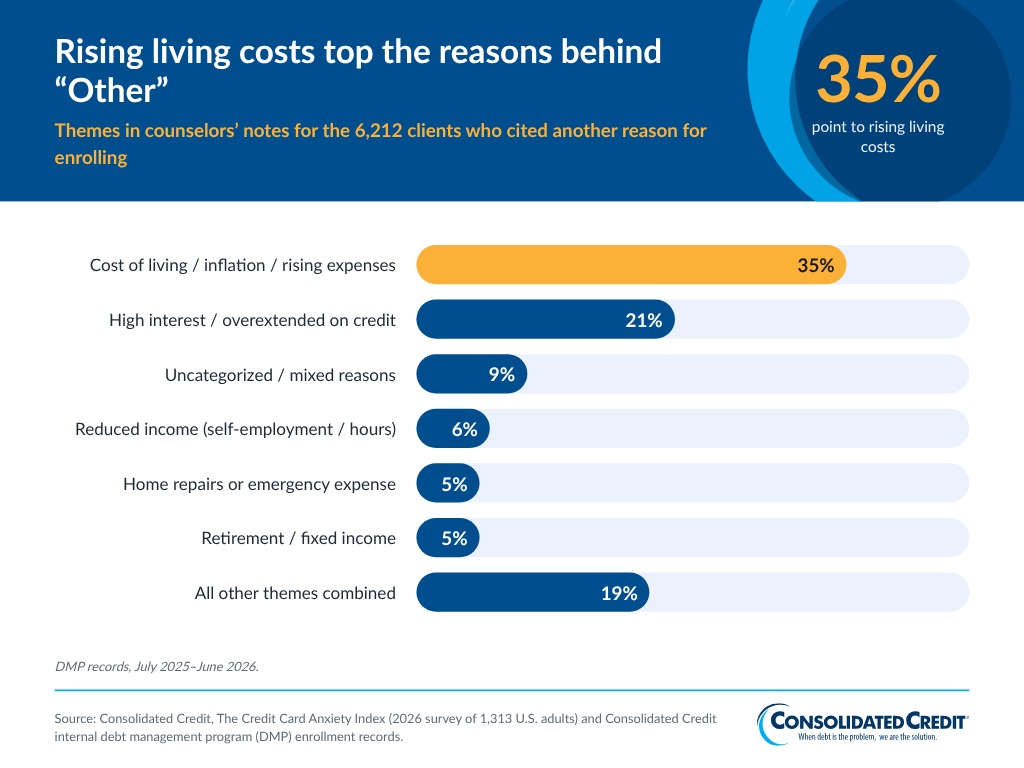
The survey’s top stated worry, interest piling up, does show up here, but it isn’t the top theme: cost of living, inflation, and rising expenses is the single most common theme in counselors’ notes on why clients needed help, with high interest and overextension a close second. Either way, the biggest driver, in both the formal reason codes and the write-in explanations, is an income or cost-of-living shock rather than the debt itself. In other words, people tend to worry about the interest; what actually pushes them to enroll is more often what happened to their paycheck or their bills.
Few worriers say they’ve sought help. Only 20% of survey respondents who worry say they’ve looked into debt help or advice.
One data point worth noting: the average debt balance at enrollment jumped to roughly $19,100 in 2025, up from about $13,400 in 2024. That’s a sharper year-over-year jump than in any prior year in this dataset. It also holds across the four states with the most enrollments (Florida, California, Texas and New York), not just in the topline number, so it doesn’t appear to be a small-sample fluke.
The bottom line
Worry about credit card debt is common: 61% of Americans say they feel it. But this index shows that the worry itself often becomes its own burden, separate from the balance that caused it. Half of worriers say it affects their mood at least several times a week. A third haven’t told anyone. And for a meaningful share, that worry has gotten heavier over the past year, not lighter.
Age changes the picture more than almost anything else in this data. Worry is highest in midlife and drops sharply after 60. But the Americans least likely to worry are also the most likely to be carrying that worry alone. And when the survey’s stated worries are checked against Consolidated Credit’s own enrollment data, the story holds up: the generations that report the most worry also make up the biggest share of enrollments, even if the specific trigger, an income or cost-of-living shock, isn’t always the same thing people say worries them most. As a first-of-its-kind measurement, this index gives Consolidated Credit a baseline for tracking whether the gap between how much people worry and how few look for help starts to close over time.
| Do you ever worry about how much you owe on your credit cards? | |
|---|---|
| Yes | 61.39% |
| No | 38.61% |
| Has worrying about your credit card balances affected your mood in everyday life? | |
|---|---|
| Yes, it intrudes upon my thoughts at least once a day. | 33.04% |
| Yes, it ruins my day 3-4 times a week. | 17.14% |
| Yes, it bothers me occasionally. | 47.83% |
| No, I never think about it. | 1.99% |
| Which best describes how credit card debt makes you feel? | |
|---|---|
| I’m in control. It doesn’t control me. | 22.86% |
| I’m a little worried about it, but it doesn’t get me down. | 46.96% |
| I’m overwhelmed and have no idea what my financial future will look like. | 22.11% |
| I’m ashamed of myself, mad at myself, and I can’t really tell anyone how I feel. | 8.07% |
| Which best describes how you feel before opening a credit card statement? | |
|---|---|
| I’m calm. | 34.16% |
| I’m a little uneasy. | 41.74% |
| I downright dread it. | 15.40% |
| I avoid opening it for as long as possible – or entirely. | 8.70% |
| What’s your biggest credit card worry? | |
|---|---|
| The interest piling up | 34.04% |
| Missing a payment | 23.73% |
| Never paying it off | 22.24% |
| The impact on credit score | 15.28% |
| Having to ask for help | 4.72% |
| Who knows how you feel about your credit cards? Check any that apply. | |
|---|---|
| No one | 33.29% |
| My spouse/significant other | 50.43% |
| A few family members | 29.94% |
| My friends | 16.77% |
| Some of my coworkers | 2.98% |
| Compared to this time last year, is your anxiety about credit card debt… | |
|---|---|
| Higher? | 41.37% |
| About the same? | 48.94% |
| Lower? | 9.69% |
| Which of these have you done because of credit card debt worry? Check any that apply. | |
|---|---|
| Cut back on non-essential spending | 65.47% |
| Avoided checking my balance or statements | 35.53% |
| Picked up extra work or a side income | 38.88% |
| Looked into debt help or advice | 20.37% |
| Nothing – the worry hasn’t changed my behavior | 9.81% |
Survey methodology: Consolidated Credit surveyed 1,313 Americans about how they feel about their credit card debt. Respondents who said they worry about their balances (806 people) were asked additional questions about how that worry affects their mood, behavior, and relationships; 805 of them answered those follow-up questions. Responses were collected through SurveyMonkey. Percentages are rounded to the nearest whole number and may not total 100 percent. This survey reflects respondents’ self-reported feelings and is intended for general educational purposes; it is not a clinical assessment of anxiety or mental health, and individual experiences vary.
Internal data methodology: Generational enrollment-share and reason-for-enrollment figures referenced in the “How This Compares to Real Enrollment Data” section are drawn from Consolidated Credit’s internal debt management plan (DMP) records: a separate, non-survey dataset covering actual client enrollments, not self-reported survey responses.


