Holidays
Credit Cards: The Debts That Keep On Compounding
39% of Americans still paying on last holiday season charges
Sunday, November 28, 2004
Jason Gertzen
Milwaukee Journal Sentinel
Swept up by the sentiment of the season and short on cash, Thorn, soon to be 23, relied on her credit cards to buy gifts for her family and splurge on a few special holiday treats. She didn't think she was spending too much: an "X-Men" DVD and a $30 video game controller for her brother; a $30 Red Lobster restaurant gift certificate for her parents; a few other presents here and there.
Then the bills arrived in January. She was stunned.
The Milwaukee Area Technical College student scraping by with a low-paying office support job had more than $500 in debt and no idea how she would pay it.
"You think it is only going to be a couple extra hundred on there," Thorn said. "Then it's, 'Wow. I spent that much?' "
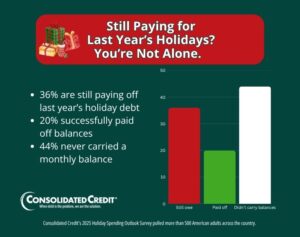
This time of year, known for its bright lights and good cheer, also has a darker side. Fully 39% of Americans still are paying off last year's holiday credit card bills, and this year's shoppers are poised to charge at least $35 billion more that they could be paying off until Christmas 2005.
"The American public kind of gets blinded by those Christmas lights," said Howard Dvorkin, president and founder of Consolidated Credit Counseling Services Inc., a non-profit company in Fort Lauderdale, Fla., that offers consumer education and financial counseling. "At no other time do people routinely get themselves in (more) trouble than during the holidays."
The average American is expected to spend $700 to $900 this year as consumers fill cash registers and online shopping sites with $220 billion in holiday spending - expectations that outstrip the means of the median American household.
Nearly half of those purchases - $108 billion - will be put on cards of all sorts - credit, charge and debit - by the estimate of CardWeb.com, a Frederick, Md., research firm that tracks the card industry.
This is a matter of convenience for most holiday shoppers, who have set aside money during the year or can squeeze the extra spending into their normal household budget. Consumers will pay 60% of the bills in full, avoiding any finance charges.
But of the $86.4 billion charged to major credit and store cards, according to the 2004 holiday retail sales report of CardWeb.com, 40%, or $35 billion, will be carried from month to month, posing a financial burden adding to the paycheck-to-paycheck struggle of many consumers.
When good intentions and generosity run up against the cold reality of budgeting, budgeting often loses. "People are overspending," said Kenny Thomas, a spokesman for San Francisco-based Visa USA.
Holiday spending should not exceed 1.5% of an individual's gross income for the year, according to Visa's calculations. By the time a person pays for housing, food, transportation and other basic living expenses, 1.5% is a reasonable amount for this type of discretionary spending, Thomas said.
The $940 average holiday spending that Visa projects for this year is destined to break the budgets of the nation's median-income households, which make about $43,000, Thomas said. Using the 1.5% guideline, a household with this income should spend no more than $650 on holiday shopping.
Karen Newsted of Franklin relies on a few simple strategies to avoid big bills after the holidays.
First, she keeps track of her purchases to make sure she stays within her budget.
Gift cards also are helpful, especially as she has seen increasingly expensive items appear on the wish lists of her five grandsons ranging in age from 7 to 17.
Newsted, a devoted coupon clipper, occasionally will take advantage of a discount on the day's purchases when she uses a particular store's credit card, but "I pay it off the next month. Otherwise it is a not a good deal," Newsted said a week ago as she was taking a break from shopping at Southridge Mall.
Credit card spending is insidious because it doesn't feel "real" to many consumers, Dvorkin said.
"People with a credit card are going to spend 30 percent more than they would with cash," Dvorkin said. "Psychologically there is no pain factor associated with credit cards. With cash, you don't want the green stuff going through your fingers."
Thorn, who still is grappling with some of last year's holiday bills, said she has cut back on spending to regain control of her monthly budget. She doesn't have cable television. No cell phone. She tried to save for this year's holidays, but expects to rely on her credit card again.
"For low-income people there is no such thing as saving money," Thorn said. "I am lucky if I can put $5 aside when I am living paycheck to paycheck."
Working in the accounting department of the Consumer Credit Counseling Service of Greater Milwaukee has taught Thorn the dangers of mismanaging her credit card accounts. Even as she charges more, Thorn makes sure she always pays at least part of the bill every month.
One missed or late payment could boost her card's low 10% interest rate to 20% or more, Thorn said.
"I don't want to destroy my credit by not paying or paying too late," she said.
Juggling her generosity, her household budget and worries about her financial future makes the holidays a stressful time, Thorn said.
"I couldn't go a Christmas without getting someone in my immediate family a present," Thorn said. "You want to show them how much you care. You want to buy them something."